







Photography by Ethan Seifert, courtesy of Ohio University Esports
By Steffen Christian Ekkehard Schmidt, DPhil; Stefan Sell, Prof Dr, DMed; and Alexander Woll, Prof Dr
There is reasonable concern about health issues caused by the absence of physical activity among activities linked to gaming and streaming.
Recent studies show that the absence of physical activity (PA) and the factors associated with intensive media use are independent risk factors for a variety of different nonspecific (eg, overweight and metabolic syndrome) and specific diseases. Besides the long-term consequences and risks of physical inactivity, negative short-term consequences from even a single event of prolonged physical inactivity have been confirmed by experimental studies. One disease that is discussed to be aligned with single periods of continuous physical inactivity is venous thromboembolism (VTE), such as was found after long air travels in the 1980 and what was described in various studies in the 2000s as seated immobility thromboembolism (SIT) among professions with prolonged sitting or standing time. With the increasing relevance of screen media in occupational and recreational lifestyles, thrombosis caused by intensive use of computers and the internet was given the new name e-thrombosis in 2003 by Beasley et al.
Prolonged gaming and streaming are serious risk factors for diseases associated with water retention in the legs, and these risks can be measured by bioelectrical impedance and reduced by wearing compression stockings. Yet, according to the researchers and to the best of their knowledge, there is a paucity of studies that have tried to identify the driving or causal factors that lead to VTE during recreational use of screen time or studies describing SIT or e-thrombosis in the context of gaming-related live streaming. Thus, the researchers set out to compare the water balance of recreational gamers with and those without compression stockings during a gaming event to determine if this population is at risk.
Methods
The study cohort comprised 46 recreational gamers (average age of 27.1 years; 11% women, 89% men), all of whom were nonpregnant and healthy, defined as the absence of a clinical condition that could influence fluid balance. The data were collected on gaming conventions in a rural area in Germany in May 2017, April 2018, and May 2019. This field study did not control for the behavior of the gamers (eg, net amount of gaming, eating, or sleeping patterns). The aim was to discuss the effect of compression stockings on different parameters of body composition measured by bioelectrical impedance analysis (BIA).
Twenty-three of the gamers wore compression stockings (VenoTrain cocoon (Bauerfeind)) for the duration of the study (intervention group (IG)), after measuring body height and calf circumference to ensure the accuracy of fit. They were advised to wear the stockings until they go to bed and wear them again immediately after awakening until the second measurement in the evening. The control group (CG) received no intervention. Participants were free to engage in any kind of activity they wanted. All participants played casually or in tournaments during the event.
Body composition and water balance were measured with 8-electrode BIA before and after 24 hours at a gaming event. The BIA measurement of resistance (R) and bioelectric reactance (Xc) was taken at a fixed frequency of 50 kHz between the right wrist and ankle, as well as the left wrist and ankle with a body impedance analyzer. R and Xc were measured at a 10-second interval until no changes in R and Xc between 2 measurements were observed, and the last measurement was noted.
Statistical tests were conducted using SPSS (version 25; IBM Corp). Statistical significance was set to P<.05 and repeated measurement analyses of variance (rmANOVAs) were used to detect significant differences between the changes among the IG and control group (CG) as of time×group interactions. Besides F and P values, effect sizes are reported through partial eta2 (p.η2).
Body weight was measured to the nearest 0.1kg with a calibrated scale and standing height was measured to the nearest 0.5 cm using a stadiometer, with the participant wearing light clothes and no shoes.
Participants were asked about and reported that they reach the PA guidelines for adults on 2.6 (IG) and 3.1 (CG) days of a normal week and 30% (7/23) of participants in both groups were active members of sports clubs. Total sedentary screen time was slightly higher in the CG, with an average of 6.7 hours per day for the total sample, including a total of approximately 2.5 hours of daily gaming.
Complaints regarding the lower extremities were tracked using a standardized numeric pain rating scale with 7 10-point items before the first BIA and immediately after the last BIA: “How do you sense your legs regarding the following symptoms: heavy legs, swollen legs, tingling, tension, pain, itching, or muscle aching? 1=no complaints to 10=very strong complaints.”
The same devices, questionnaires, and electrodes were used every year, and similar weather conditions occurred. The gaming convention always started on Friday and ended on Sunday. The pretest assessment was hosted on Friday from 6 PM until midnight, and participants joined the post-test assessment after 24 hours.
Results
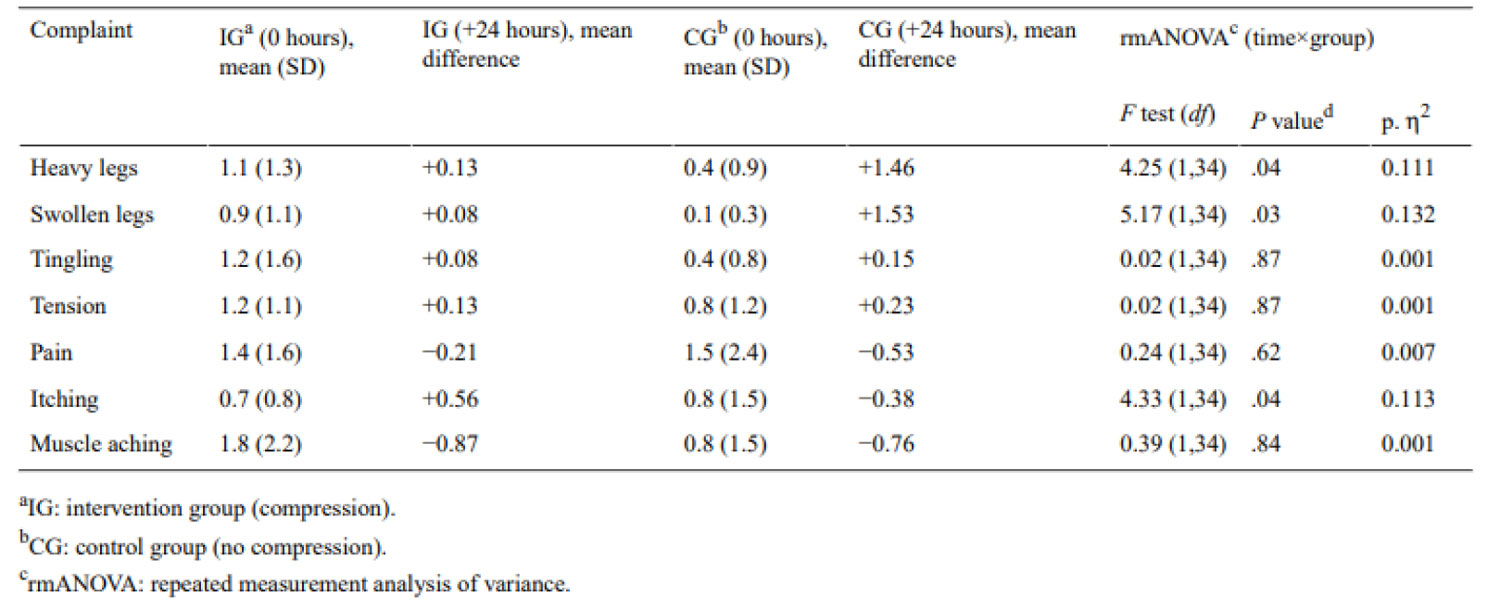
Table 1. Complaints regarding the legs directly before and after the bioelectrical impedance analysis measurements
This study shows that prolonged gaming and associated behaviors during a 24-hour period led to an increase in total body water (+0.76 L; P<.001) and a decrease of phase angle (PhA; a direct measurement of cell integrity and the distribution of water within and outside the cell membrane) in the lower extremities (−0.47°; P<.001) but not in the upper extremities (+0.09°; P=.80), when no compression is used. Gamers using compression socks did not show significant negative effects on their body composition.
Both groups showed a comparable range of age except for 1 older participant in the CG. Mean weight gain during the event was +0.8kg and translated into a 0.2-point increase in body mass index.
R, Xc, and all the derived parameters remained stable in the IG. Among the CG, R, Xc, and PhA significantly declined, whereas total body water (TBW) significantly increased, and a 0.8kg increase in extracellular mass (ECM) was close to statistical significance (P=.05). The rmANOVAs revealed significant time and group interactions among R, Xc, PhA, and TBW. Descriptive differences in the change of ECM between groups were on the edge of statistical significance (F1,44=3.56; P=.06; p. η 2 =0.075), with the IG losing 0.2kg and the CG gaining 0.8kg during the event.
The segmental BIA analyses showed no significant effects for time or time×group interactions for the upper extremities. Significant effects of time and time×group interactions were found for all lower extremity parameters. Participants without compression showed a mean decrease of −11.4 Ω for R and −3.1 Ω for Xc, resulting in a mean decrease of the PA by 0.47 units, whereas participants with compression showed a slight increase of R (mean +3.6, SD 10.7 Ω), Xc (mean +0.9, SD 2.1 Ω), and PA (mean +0.09, SD 0.37 units).
Participants’ complaints concerning their lower extremities directly before the first and after the last BIA measurements are shown in Table 1. Participants without compression complained significantly more about heavy legs (F1,34=4.25; P=.04; p. η 2 =0.111) and swollen legs (F1,34=5.17; P<.001; p. η2=0.132) compared with participants with compression. Participants with compression reported significantly more itching (F1,22=4.33; P=.04; p.η2=0.113).
Discussion
This study shows that extensive screen time use by gamers can cause short-term effects on water balance and its allocation among body compartments, which can be measured by BIA and prevented by compression stockings:
Prolonged gaming and associated behaviors cause a significant increase in TBW, which can be measured by BIA: The researchers found a significant increase of 0.76 (1.20) L in TBW among the CG. Of the 23 participants in the CG, 14 showed increased TBW (mean +1.4, SD 1.1 L), 2 showed no changes, and 7 participants showed decreased TBW (mean –0.3, SD 0.2 L).

Prolonged gaming and associated behaviors cause a significant increase in body water as measured by a decrease in local R among the lower extremities but not the upper extremities: In this setting, no significant increase in R in the upper extremities of participants in both groups was found. However, in the lower extremities the CG showed a mean decrease in R of –11.4 (SD 15.8) Ω, whereas the IG showed a slight increase of +3.6 (SD 10.7) Ω.
 Prolonged gaming and associated behaviors cause a decrease in bioelectrical PhA in the lower extremities, which indicates an overall stronger pronounced increase in extracellular fluids compared with intracellular fluids: The CG showed a decrease in mean PhA by –0.23 degrees for the whole body and –0.47 degrees for the lower extremities, whereas the PhA of the IG remained relatively stable at +0.01 degrees for the whole body and +0.08 degrees for the lower extremities. Analyses of variance showed large effect sizes with 43% (lower extremities) and 31.4% (whole body) explained variance among the PhA change throughout compression. As PhA is a ratio between Xc and R, it increases with the ability of cells to function as an alternating current resistor, which in turn increases with the quantity of intracellular fluid, which is a predictor of cell nutrition and functioning and ultimately motor performance. This can be interpreted as a meaningful positive effect of compression stockings during gaming and associated behaviors.
Prolonged gaming and associated behaviors lead to an increase in ECM but not in intracellular mass (ICM): No changes in ICM were found among both groups but there was a marginal decline of 0.2kg in ECM among the IG and a 0.8kg increase of ECM among the CG. With P=.06, the time and group interaction for ECM was at the edge of statistical significance. Further studies are needed to confirm or reject the hypothesis that an increase in TBW after prolonged gaming is mainly owing to an increase in extracellular but not intracellular fluid mass.
The use of compression stockings can reduce the decrease in PhA and the increase in TBW: Descriptive statistics and significant time and group interactions with effect sizes of 31.4% and 43% explained variance for the whole body and the lower extremities found by rmANOVAs show that compression can level out the accumulation of water after 1 day of gaming and associated behaviors. On average, the IG showed increased PhA during the study, which indicates the effectiveness of compression stockings as a preventive action during prolonged gaming.
Conclusion
The researchers conclude from their data that the use of compression stockings during prolonged gaming and streaming lowers the risk for diseases caused by seated immobility, such as SIT, VTE, and deep venous thrombosis; however, future studies are needed to provide tailored recommendations. Additionally, as there is no specific textile or clothing related to professional gaming and streaming yet, there is a considerably large market for compression stockings among gamers and live streamers. Experimental studies on the dose–response mechanism of compression and large-scale epidemiological studies on the risk for SIT or e-thrombosis with and without compression are needed.
This article has been excerpted from “The Use of Compression Stockings to Reduce Water Retention in the Legs During Gaming and Esports: Randomized Controlled Field Study” Interact J Med Res 2022;11(2):e25886. doi: 10.2196/25886. PMID: 36173666. PMCID: 9562085. Editing has occurred, including the renumbering of tables, and references have been removed for brevity. Use is per CC BY 4.0.