








 By Jeffrey Kuhn, PhD
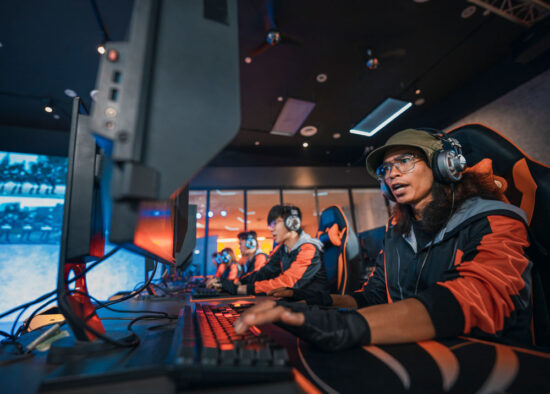
Modern esports took shape in the early 2000s and experienced slow, steady growth over the next two decades. Individual players, then small casual teams, and then professional esports organizations gradually grew the industry from a collection of ad hoc tournaments to today’s $2 billion-a-year global enterprise where international teams compete for prize pools upwards of $60 million. Seeing this growth, universities began to see esports as a viable student recruitment and retention tool as fans of esports and the age demographic universities seek to recruit are the same. In 2014, Robert Morris University became the first university to have an official university team. Since then, over 400 colleges and universities nationwide have developed esports programs.
These programs lean heavily on the business and competitive side of esports with students able to earn certificates or degrees in esports management, event planning, or Internet technology infrastructure. What has been slower to develop are academic programs focusing on players’ health and wellness, and research on the health of esports players has only recently become more available with a significant number of esports health studies only having occurred since 2019.
Those familiar with traditional athletics may assume esports teams have physical fitness requirements and trainers with whom they work to ensure health and wellness. Esports, however, are not under the auspices of the NCAA and therefore not beholden to set standards on player health. They also receive far less funding than traditional athletics and so are often unable to afford the player support that traditional sports teams have. Instead, it is up to individual teams or the conferences in which they participate to put a priority on player health. The challenge is most directors of esports programs have no background in health or sports medicine.
This results in esports programs assembling ad-hoc standards for player health with a focus on the most reported player issues: eye fatigue, neck and back pain, and wrist pain as these are the factors most associated with a player’s performance in-game.1 As McGee asserts, gamers demonstrate a lack of understanding of the importance of lower extremity health while playing and practicing.2 Most esports players report practicing and playing for 2 to 6 hours a day but are unaware of the effects prolonged sitting can have on their bodies. Schmidt, Sell, and Woll found that gamers are at risk for complications due to water retention in their legs, but acknowledge that more research in this area is needed due to their study being unable to control non-gaming behaviors such as sleep, eating habits, or break periods.
To advance research in esports health and wellness 2 conditions need to be met. First, esports players, and those overseeing collegiate esports programs, need a more robust understanding of the risk factors associated with prolonged gaming. It could be argued that esports players share the most similarity with racing drivers in that they are expected to remain seated for extended periods while engaged in high stress contexts, and perhaps examining health and wellness among drivers is where esports players can begin to better understand their own health needs.
The second condition that needs to be met is for medical researchers to develop a more robust understanding of esports as the way esports is reported in current medical research is murky at best. Examining esports medical literature there appears to be a conflation of the terms esports and gaming. While these terms are similar, there are critical differences between the behaviors of the players that can result in shifting the outcomes of medical research. A Valorant esports player who plays short 30-minute rounds with 10-minute breaks in between for a few hours a day has more opportunity for stretching and self-care than a gamer who plays World of Warcraft where a dungeon raid may require hours of sustained focus and getting up from the keyboard and moving about are not feasible. These 2 types of players have different characteristics and to better isolate how those characteristics can influence player health, medical researchers need a more comprehensive understanding of how they play.
Dr. Jeff Kuhn is the Esports Director at Ohio University and serves in the J. Warren McClure School of Emerging Communication Technologies in the Scripps College of Communication. He works with faculty to integrate technology into their classroom practice and bring game-based learning into classroom practice. He frequently delivers talks and keynote addresses on game design, games and learning, and the need for games literacy among educators.
- DiFrancisco-Donoghue J, Balentine J, Schmidt G, et al. Managing the health of the eSport athlete: an integrated health management model. BMJ Open Sport Exerc Med. 2019;5:e000467. doi:10.1136/bmjsem-2018-000467
- McGee C. Lower extremity disorders in esports. In Handbook of esports medicine (Migliore L, McGee C, Moore M, Eds). Springer; 2021.
- Madden D, Harteveld C. “Constant pressure of having to perform”: Exploring player health concerns in esports. Paper presented at conference on Human Factors in Computing Systems. Yokohama, Japan. May 8-13, 2021. https://doi.org/10.1145/3411764.3445733
- Schmidt SCE, Sell S, Woll A. The use of compression stockings to reduce water retention in the legs during gaming and esports: Randomized controlled field study. Interact J Med Res. 2022;11(2):e25886.