







By Kim T. M. Opdam, Ruben Zwiers, Johannes I. Wiegerinck, C. Niek van Dijk, and Ankle Platform Study Collaborative – Science of Variation Group
It has been customary practice for medical terms to be named after a person—familiar eponymous terms serve as shorthand during communication with colleagues. Specifically, as it relates to tendon–related disorders, several of these disorders can be distinguished and for each pathology different definitions and terms or eponyms arose over time. For example, the indistinct Haglund eponyms are still frequently used in Achilles tendon–related terminology. Moreover, the terminology for Achilles tendon–related disorders is inconsistent and confusing. Initially terms were used such as “cellulite peritendineuse,” “tendinitis Achillae traumatica,” “paratendinitis,” “tenosynovitis,” and “peritendinitis.” The term “achillodynia” was introduced as a descriptive term for Achilles tendon–related pain. Subsequently terms were based on histological findings and a subdivision was made into insertional and non-insertional Achilles tendon problems.
Maffulli et al observed that terminology used for tendon conditions was misused and confusing. In their opinion, definitions such as tendinitis, tendinosis, and paratendonitis can only be diagnosed after biopsy; however, they were often used in clinical practice without histopathologic examination. Due to a lack of consistence in nomenclature, Maffulli et al advocated to use the term tendinopathy to describe clinical overuse conditions characterized by pain and swelling around the tendon and impaired performance. Depending on the affected tissue, the terms tendinopathy, paratendinopathy, or pantendinopathy were proposed.
By Kim T. M. Opdam, Ruben Zwiers, Johannes I. Wiegerinck, C. Niek van Dijk, and Ankle Platform Study Collaborative – Science of Variation Group
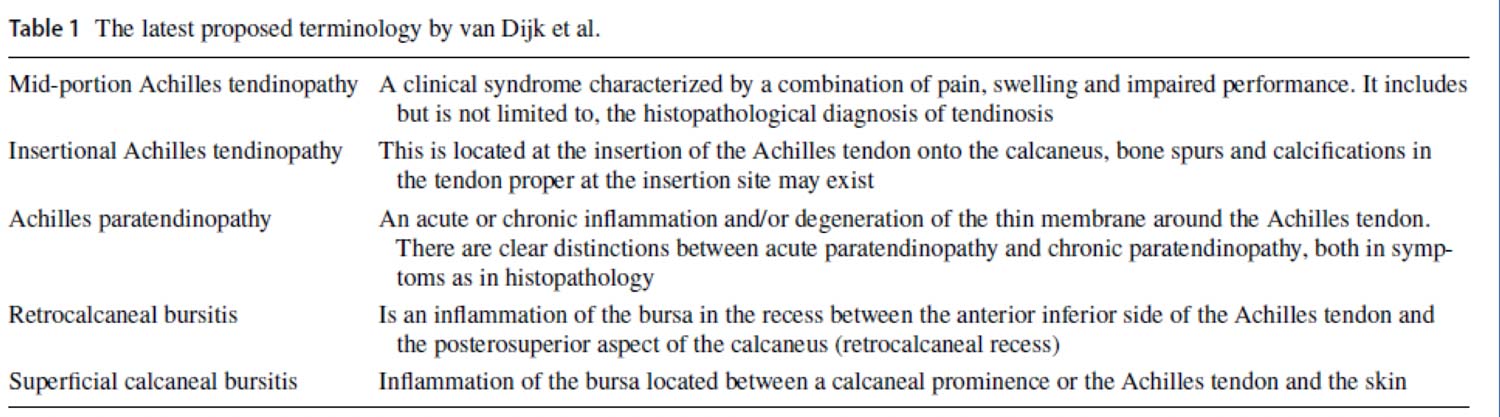
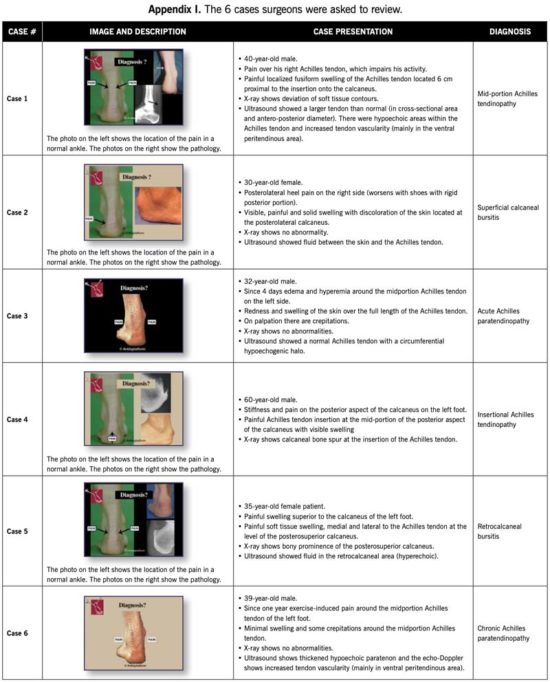
In 2011, an addition was proposed to further purify the terminology used in Achilles tendon–related disorders to effectuate uniform and clear terminology. This terminology is based on anatomic location, symptoms, clinical findings, and histopathology and consists of the following 5 terms: mid-portion Achilles tendinopathy, insertional Achilles tendinopathy, Achilles paratendinopathy, retrocalcaneal bursitis, and superficial calcaneal bursitis (see Table).
Uniform terminology provides the ability to communicate with a universal language in daily practice amongst clinicians and researchers. Toward this end, the Ankle Platform Study Group set out to survey and evaluate the current terminology and assess the latest proposals on terminology used for Achilles tendon–related disorders.
Methods & Results
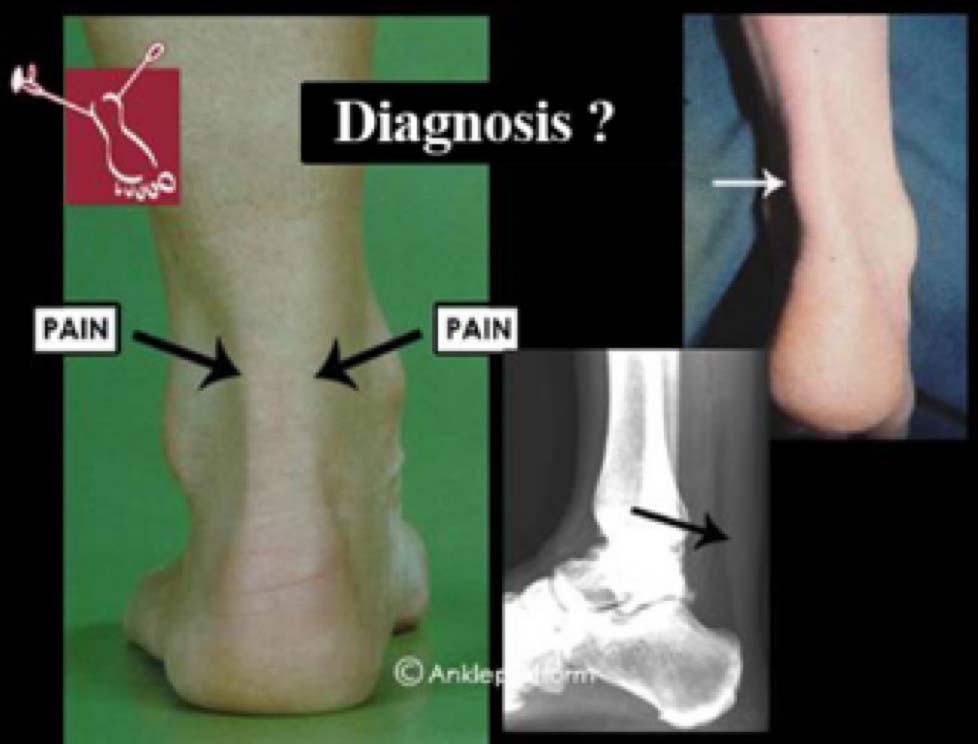
All orthopedic surgeons experienced in the field of foot and ankle surgery who are members of the Ankle Platform Study Group—Science of Variation Collaborative were invited to participate in this survey by logging on to the website www.Ankle Platform.com* (see Note at end). Fully completed responses were received from 141 of the 283 (50%) orthopedic surgeons from around the world. They were requested to fill out a survey on terminology in 6 typical cases with Achilles tendon–related disorders (see Appendix I, page 25). Participants were asked to give their preferred diagnosis for each case presented. In 5 out of 6 cases with Achilles tendon-related disorders, the majority gave an answer according to latest proposals.
The second part of the study comprised a systematic literature search of Achilles tendon–related disorders in 8 foot and ankle journals in Medline, Embase (Classic) from 2000 to 2016: the American Journal of Sports Medicine, British Journal of Sports Medicine, Knee Surgery Sports Traumatology Arthroscopy, Foot & Ankle International, Journal of Orthopedic Research, Acta Orthopedica, Journal of Foot and Ankle Research, and Journal of Foot and Ankle Surgery.
All articles on Achilles tendon–related disorders, except Achilles tendon ruptures, published from 2000 until 2016 were included. Title and abstract were screened, and the used terminology was extracted. All extracted terms were counted and divided into “according to the latest proposals” and “not according to the latest proposals,” based on anatomic location, symptoms, clinical findings, and histopathology, which was published January. When multiple terms were used in 1 publication, for example mid-portion Achilles tendinopathy and insertional Achilles tendinitis, this was scored as “not according to the latest proposals.” All terms described in publication about terminology of Achilles tendon–related disorders in 2011 were used. Literature was reviewed for the terminology used in papers on Achilles tendon–related disorders and thereafter a systematic literature search was performed.
After the search, 244 articles were reviewed. The terms most used in literature from 2000 to 2016 are (chronic) Achilles tendinopathy, mid-portion Achilles tendinopathy, and (chronic) Achilles tendinosis. Also, eponyms were still frequently used. In 2000, 20% used terminology according to the latest proposals based on anatomic location, symptoms, clinical findings, and histopathology and in 2016, 93%. In 2000, 33% used terminology according to the latest proposals and in 2016, 100%. In 2000, 0% used terminology according to the latest proposals for insertional Achilles tendinopathy and retrocalcaneal bursitis and in 2016, 80%.
 Achilles-TableDiscussion
The main findings of this study were that terminology for Achilles tendon–related disorders according to the latest proposals based on anatomic location, symptoms, clinical findings, and histopathology is being used by the majority of orthopedic surgeons in daily practice and is increasingly being used in the literature. However, the indistinct Haglund eponyms are still frequently used in Achilles tendon–related terminology.
The wide variety in terminology for Achilles tendon–related disorders is confusing. The term that represents the entity must be neutral yet descriptive, uniform, and clear. Therefore, descriptive terms are preferable to eponymous terms. Terminology that includes the combination of anatomic location, symptoms and clinical findings, and pathological changes for each entity has, therefore, been advocated.
Symptoms around the Achilles tendon often have a similar presentation and it is, therefore, important to define the pathology or the combination of pathologies. For example, lack of distinction between entities, such as insertional tendinopathy and chronic retrocalcaneal bursitis, is crucial to determine further treatment and it impedes the process for researchers to perform an all-encompassing systematic review.
In 5 out of 6 cases in the survey, the majority of orthopedic surgeons gave a diagnosis according to the terminology based on anatomic location, symptoms, clinical findings, and histopathology. The exception is the fifth case, where the majority choose Haglund’s disease instead of retrocalcaneal bursitis. A possible reason for this is the ingrained use of the eponym Haglund. There are approximately 20,000 medical eponymous terms in use today and the literature shows that using eponymous terms is an inaccurate and unreliable method of communication. Somford et al questioned 244 orthopedic surgeons worldwide on common eponymous terms and reported a low agreement on use of eponymous terms (kappa 0.11; proportion of agreement, 68%). Nevertheless, eponymous terms are often used in clinical setting and are passed on to the residents and students. Also, eponymous terms used in the published articles are often inconsistent and do not match their original definition.
Terminology in which Haglund eponyms such as Haglund’s deformity, Haglund’s syndrome, and Haglund’s disease are all dissimilar entities that should be avoided, because there is a large variation in the presumed meaning of these eponymous terms. Haglund’s syndrome was first defined as a common cause of posterior heel pain, characterized clinically by a painful soft tissue swelling at the level of the Achilles tendon insertion. Haglund’s deformity was first described as a tender swelling in the region of the Achilles tendon with visible prominence of the posterolateral aspect of the calcaneus. Haglund’s disease, however, refers to osteochondrosis of the accessory navicular bone.
In systematic reviews, many eponymous diagnoses have to be converted to anatomical diagnostic groupings and at all studies are excluded based on aberrant or uninterpretable definitions of an eponym or pathology, which can lead to different research results, which are often leading for the best scientific-based treatment in clinical practice.
Uniform terminology provides the ability to communicate with a universal language in daily practice amongst clinicians and researchers and will lead to the best available scientific-based treatment in clinical practice.
Conclusion
The revised terminology for Achilles tendon–related disorders is used by the majority of orthopedic surgeons and is increasingly used in the literature. However, the indistinct Haglund eponyms are still frequently used in Achilles tendon–related terminology.
*Note: The Ankle Platform (www.ankleplatform.com) was developed for orthopedic surgeons who have a special interest in the ankle and hindfoot. The aim is to share knowledge and techniques of the Amsterdam Foot & Ankle School and to improve skills on ankle and hindfoot pathology. The techniques are developed by Dutch Orthopedic surgeon Niek van Dijk, MD, and his team in the AMC Hospital in Amsterdam. Today Ankle Platform has members from 115 countries worldwide.

This article has been excepted from “Increasing consensus on terminology of achilles tendon‑related disorders,” by the authors noted above, which was published online on May 15, 2021, in the journal Knee Surgery, Sports Traumatology, Arthroscopy. 2021;29:2528–2534. doi.org/10.1007/s00167-021-06566-z. Editing and summarization have occurred, including the renumbering of tables, and references have been removed for brevity. Use is per CC BY 4.0.