







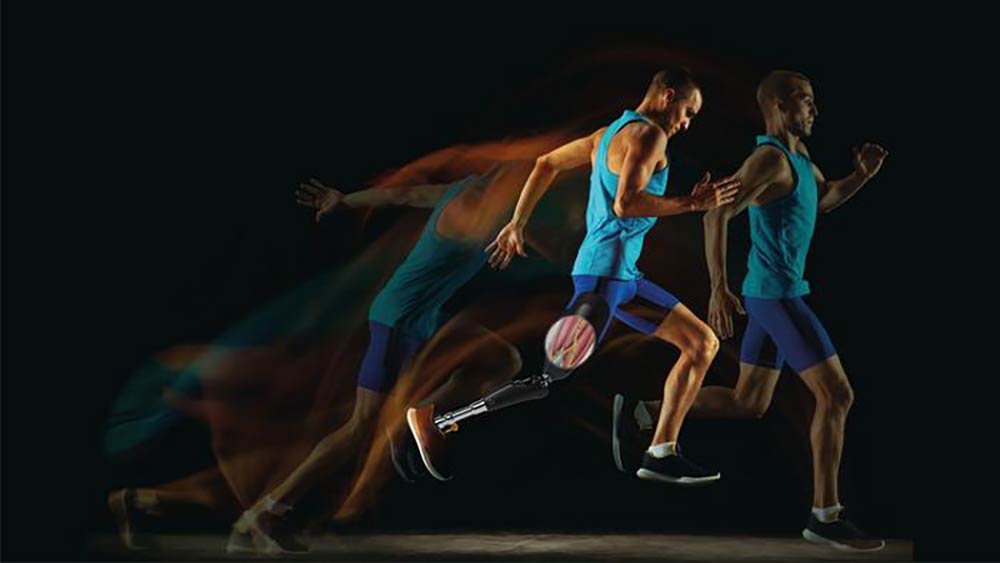
Decoding motor intentions directly from within peripheral nerves may enable more natural and intuitive control of prosthetic limbs. In the study, researchers successfully interpreted signals from the sciatic nerve of above-knee amputees with high accuracy using AI-based spiking neural networks that mimic biological neural communication.
A research team led by researchers at Chalmers University of Technology in Sweden has successfully decoded leg movements directly from the remaining nerves in people with transfemoral amputations. Using novel implantable neurotechnology and an artificial intelligence (AI) method based on the nervous system’s own “language,” the researchers could interpret detailed movements—even the will to wiggle toes. This technology opens the way to future leg prostheses that feel and act more like a natural part of the body. The new study was published in Nature Communications.
According to Giacomo Valle, assistant professor at Chalmers and one of the study’s senior authors, the research group has succeeded in meeting this challenge with a new approach, focusing on individuals with lower-limb amputations, in which the key role is played by a neurotechnological implant, combined with a new, AI-based algorithm. The technique is based on so-called Spiking Neural Networks (SNNs), which processes time-based signals known as spikes. According to Elisa Donati, professor at the University of Zurich and ETH Zürich and the other senior author of the study, these signals mimic more closely how biological neurons communicate.
“With this approach, we were able to map specific nerve signals to specific movements and predict, with high accuracy, which movements the participants were attempting,” said Valle. “The method provides the opportunity to interpret very specific leg movements for the knees, ankles, and toes–even those that were previously impossible to decode.”
Another advantage is that the technology is bidirectional so it can be used for both motor control and restoring sensation, with a single implant. “So, for the first time, a single neurotechnology can provide both natural neural control and sensory feedback in the same implantable device,” said Valle.
The study is a proof of concept, demonstrating that the technique is feasible. The next step is to test it on real prostheses.