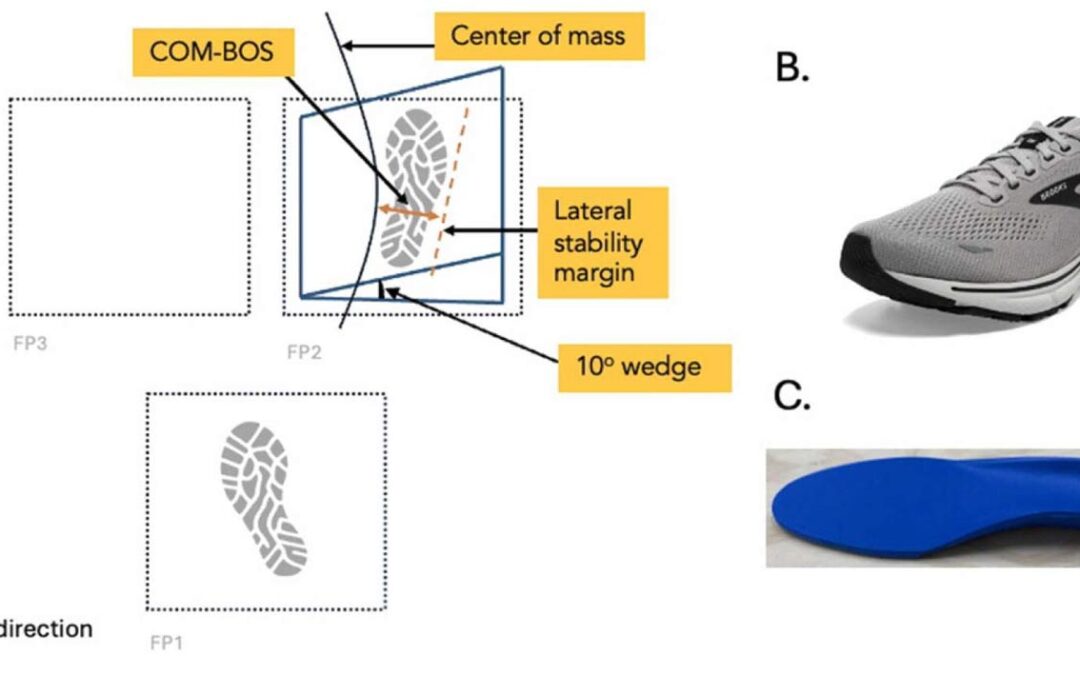









Fig. 1. An example of the walking trajectory, lateral stability margin, and wedge that altered the stepping orientation of the foot placement during the stance phase of gait (A). The 10-degree wedge is increasing ankle eversion in this illustration. The foot orthotics (C) were inserted into the Brooks Ghost shoes (B) for all orthotics conditions.
Foot orthotics, a device which can modify the mechanical interaction between foot and the external environment, are commonly prescribed for individuals with pes planus foot postures. The purpose of this study was to investigate the role of foot orthotics on controlling dynamic stability when females with pes planus foot posture experience a modified foot placement orientation during walking.
Kinematic data were collected from 18 healthy young females (21.8 ± 3.2years) walking in prefabricated foot orthotics under 3 different stepping orientations. Outcome measures included gait parameters and dynamic stability.
Results suggest that changing the orientation of the foot significantly challenges the balance control system, as evidenced by a reduction in step length, increased step width, and increased antero-posterior center of pressure of support (AP-COP) maximums. In orthotics, inverting the foot significantly reduced the center of mass-base of support (COM-BOS) range and AP COM-COP maximum whereas everting the foot increased the AP COM-COP maximum
As the foot becomes more flexible the reduction in COM-BOS range suggests an increased balance control resolution when walking in foot orthotics.
Source: Robb KA, Tameer R, Crowley P, Perry SD. Investigating the effect of foot orthotics on dynamic stability in females with pes planus foot posture. Gait Posture. 2026;124:110057. doi: 10.1016/j.gaitpost.2025.110057.