









By Asghar Rezaei, Sandesh G. Bhat, Chih-Hsiu Cheng, Robert J. Pignolo, Lichun Lu, and Kenton R. Kaufman
Adequate muscle strength, efficient gait, and good balance, which decline with age, are crucial contributors to independence and well-being.
 Aging is often associated with disability and multiple health concerns. To address these challenges, effective interventions are essential. This study investigated potential age-related declines in gait, balance, and strength and also sought to assess any relationships between these 3 parameters and explore potential differences between women and men.
Methods
Healthy individuals over 50 years of age were recruited for this cross-sectional study. Grip strength and knee strength of the dominant side were measured. Static balance was performed on the force plate in different situations each for 30 seconds: bilateral stance with eyes open, bilateral stance with eyes closed, as well as dominant leg and non-dominant leg unilateral stance with eyes open. Gait was measured during level walking using an optical motion capture system. Additionally, the dynamic stability margin (DSM) was calculated for the level walking trials.
Results
The study results indicated that gait parameters were not significantly affected by age (p≥0.12), while knee and grip strength, along with several balance parameters, showed a significant decline with age (Figure 1).

Figure 1: Normalized (a) dominant grip strength (R2 = 0.39, p < 0.001) and (b) dominant knee strength (R2 = 0.25, p = 0.005) for male and female subjects.
All individuals were able to maintain their bipedal balance, but their center of pressure (CoP) movement increased significantly by age (p≤0.028). Z-scores were calculated to compare significant age parameters. Unipedal stance time was found to be the most affected by age compared to other contributing factors (p≤0.001) (Figure 2). The duration of unipedal balance showed the most significant change per decade (non-dominant: -0.62 SDs; dominant: -0.53 SDs), while strength measures exhibited the lowest amount of change per decade (grip strength: -0.34 SDs; knee strength: -0.26 SDs). Sex differences were observed exclusively in strength parameters, with no discernible impact on the decline in balance parameters.
Discussion
The importance of balance, especially in unipedal stance, arises from the fact that it requires multiple sensory inputs and neuromuscular control, in addition to adequate muscle strength. This is why balance on 1 leg, as demonstrated in this study, undergoes the fastest decline in this healthy cohort, reflecting age-related declines in muscle strength similar to prior studies, and in the rapid coordination and integration of data by the central nervous system.
While all the subjects were easily able to maintain their balance during bilateral stance tests, these study results showed that their CoP movements increased significantly with age, which were in accordance with prior studies, showing that the bipedal balance deteriorated with age. While aging affects both muscular and neurological aspects, standing on both limbs for only 30 seconds does not require a large amount of muscle strength. This can mean that increased CoP movement due to aging may suggest a greater decline in the neuromuscular sensory system compared to strength.
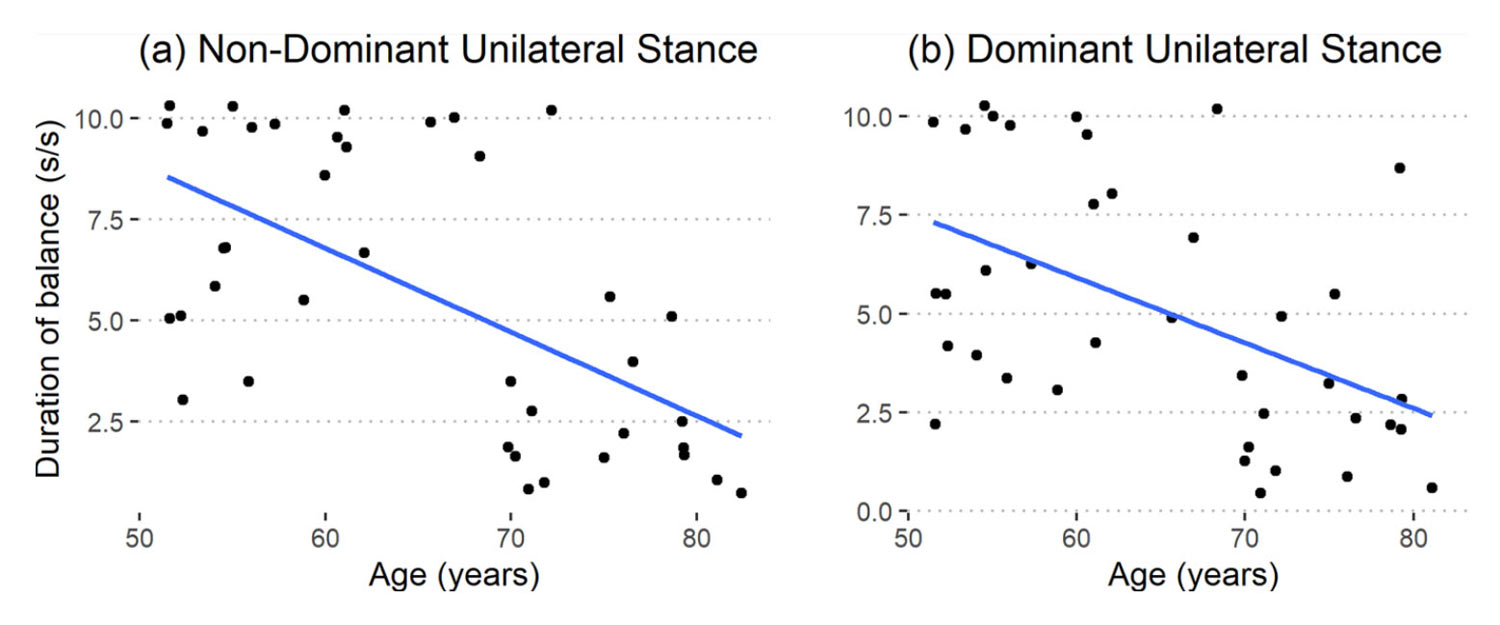
Figure 2: Unipedal standing duration for the (a) non-dominant (R2 = 0.38, p < 0.001) and (b) dominant sides (R2 = 0.27, p = 0.004).
Muscle strength serves as an additional indicator of muscle quality and a predictor of various health concerns, such as disability and mortality. Unlike level walking or balance tests, maximal muscle strength evaluates the greatest capacity of the muscle, which declines with age. The grip strength test, a simple and reliable measurement, has been recognized as a powerful predictor of disability, mortality, and morbidity. The current study observed a significant decline in grip strength, which decreased at a faster rate than knee strength. This trend aligns with findings from a longitudinal study, where grip strength was reported to decline more rapidly than hip or knee strength. Hence, grip strength serves as a better predictor of musculoskeletal aging than other strength measures.
Sex differences were observed in knee and grip strength parameters, even when the strength data were normalized by the weight and size of individuals. However, there were no sex-specific age-related declines in strength parameters, indicating that all individuals experienced declines in upper and lower extremity strength at a similar rate. No sex differences were identified in the gait and balance parameters studied in the current article, suggesting that both male and female subjects were equally affected by age similar to prior studies.
Conclusions
This study underscores the significance of the unipedal balance test in monitoring elderly subjects in the community, regardless of sex. The duration an individual, whether male or female, can maintain balance on 1 leg emerges as the most reliable determinant of aging, surpassing strength, gait, and other balance parameters. This finding is significant because this measurement does not require specialized expertise, advanced tools, or techniques for measurement and interpretation. It can be easily performed, even by individuals themselves.
Asghar Rezaei, affiliation: Department of Orthopedic Surgery, Division of Orthopedic Research, and Department of Physiology and Biomedical Engineering, Mayo Clinic, Rochester, MN.
Sandesh G. Bhat, affiliation: Department of Orthopedic Surgery, Division of Orthopedic Research, Mayo Clinic, Rochester, MN.
Chih-Hsiu Cheng, affiliation: School of Physical Therapy and Graduate Institute of Rehabilitation Science, College of Medicine, and Bone and Joint Research Center, Chang Gung Memorial Hospital, Linkou, Taoyuan, Taiwan.
Robert J. Pignolo, affiliation: Department of Medicine, Divisions of Geriatric Medicine and Gerontology, Endocrinology and Hospital Internal Medicine, and the Robert and Arlene Kogod Center on Aging, Mayo Clinic, Rochester, MN.
Lichun Lu, affiliation: Department of Orthopedic Surgery, Division of Orthopedic Research, and Department of Physiology and Biomedical Engineering, Mayo Clinic, Rochester, MN.
Kenton R. Kaufman, affiliation: Department of Orthopedic Surgery, Division of Orthopedic Research, Mayo Clinic, and Department of Physiology and Biomedical Engineering, Mayo Clinic, Rochester, MN.
This article has been excerpted from “Age-related changes in gait, balance, and strength parameters: A cross-sectional study.” PLoS ONE 19(10): e0310764. https://doi.org/10.1371/journal.pone.0310764. Editing has occurred, including the renumbering or removal of tables and figures, and references have been removed for brevity. Use is per CC.