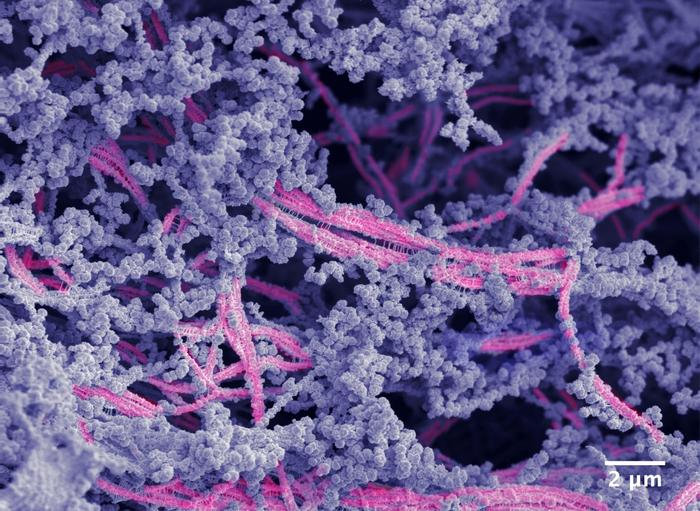
A microscropy image of the new biomaterial. Nanofibers are pink; hyaluronic acid is shown in purple. Image courtesy of Samuel I. Stupp, Northwestern University.
Northwestern University scientists have developed a new bioactive material that successfully regenerated high-quality cartilage in the knee joints of a large-animal model. Although it looks like a rubbery goo, the material is actually a complex network of molecular components, which work together to mimic cartilage’s natural environment in the body.
The researchers tested the material in sheep with cartilage defects in the stifle joint, a complex joint in the hind limbs similar to the human knee. Much like humans, sheep cartilage is stubborn and incredibly difficult to regenerate. Sheep stifles and human knees also have similarities in weight bearing, size and mechanical loads. Within 6 months, the researchers observed evidence of enhanced repair, including the growth of new cartilage containing the natural biopolymers (collagen II and proteoglycans), which enable pain-free mechanical resilience in joints.
The new biomaterial comprises 2 components: a bioactive peptide that binds to transforming growth factor beta-1 (TGFb-1)—an essential protein for cartilage growth and maintenance—and modified hyaluronic acid, a natural polysaccharide present in cartilage and the lubricating synovial fluid in joints. Stupp’s team integrated the bioactive peptide and chemically modified hyaluronic acid particles to drive the self-organization of nanoscale fibers into bundles that mimic the natural architecture of cartilage. The goal was to create an attractive scaffold for the body’s own cells to regenerate cartilage tissue. Using bioactive signals in the nanoscale fibers, the material encourages cartilage repair by the cells, which populate the scaffold.
With more work, the researchers say the new material someday could potentially be used to prevent full knee replacement surgeries, treat degenerative diseases like osteoarthritis, and repair sports-related injuries like anterior cruciate ligament tears.