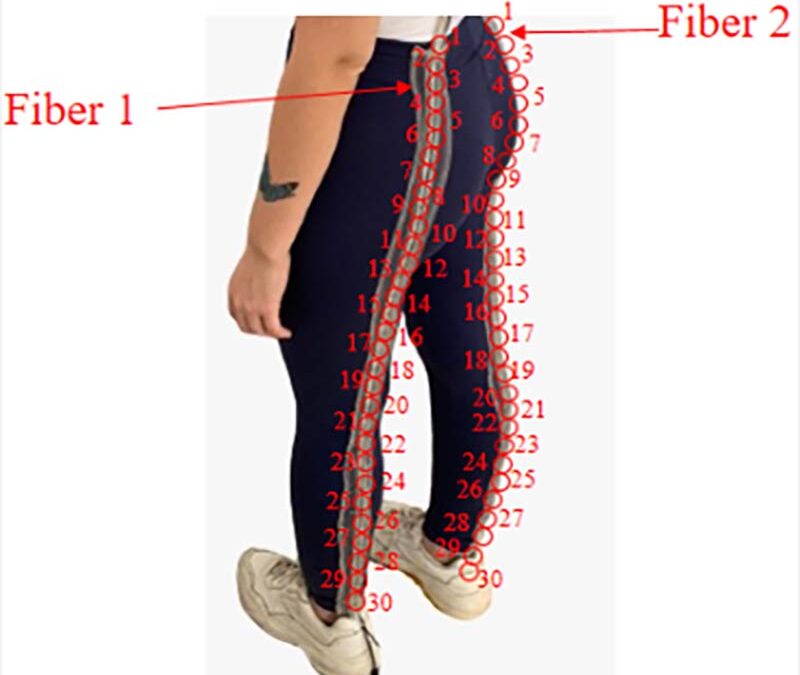








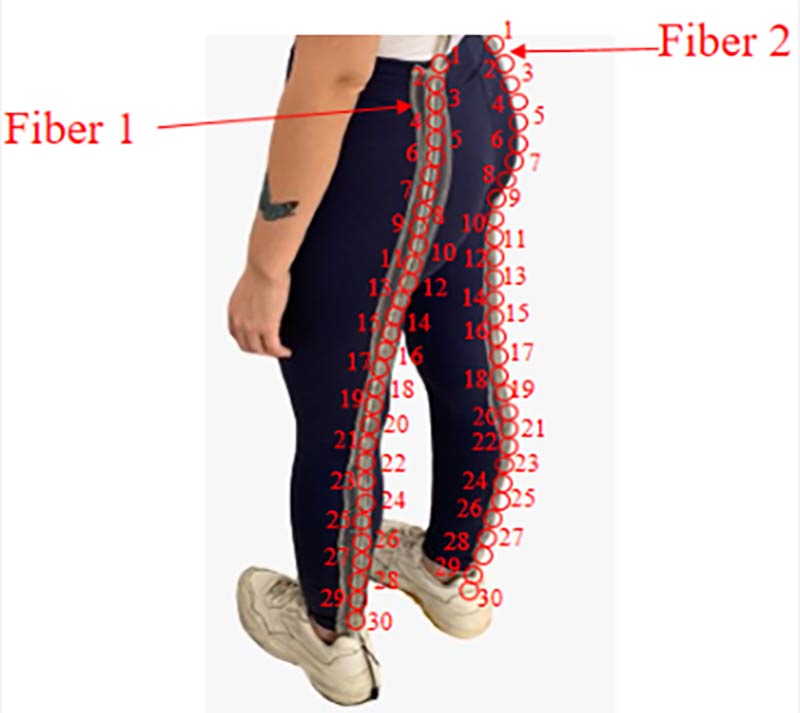
Researchers have developed smart pants that use fiber optic sensors to non-invasively track a person’s movements and activities. They detect 30 measurement points on each leg. Image courtesy of Arnaldo Leal-Junior, Federal University of Espirito Santo.
New smart pants, which feature transparent optical fibers directly integrated into the textile, could help offer a nonintrusive way to track a person’s movements and issue alerts if there are signs of distress.
The technology incorporates intensity variation polymer optical fiber sensors directly into fabric that was then used to create pants. The sensors were based on polymethyl methacrylate optical fibers that are 1mm in diameter. The researchers created sensitive areas in the fibers by removing small sections of the outer cladding fiber core. When the fiber bends due to movement, this will cause a change in optical power traveling through the fiber and can be used to identify what type of physical modification was applied to the sensitive area of the fiber. By creating these sensitive fiber areas in various locations, the researchers created a multiplexed sensor system with 30 measurement points on each leg. They also developed a portable signal acquisition unit that can be placed inside the pants pocket and a new machine learning algorithm to classify different types of activities and gait parameters based on the sensor data.
To test their prototype, volunteers wore the smart pants and performed specific activities: slow walking, fast walking, squatting, sitting on a chair, sitting on the floor, front kicking and back kicking. The sensing approach achieved 100% accuracy in classifying these activities.
“This research shows that it is possible to develop low-cost wearable sensing systems using optical devices,” said research team leader Arnaldo Leal-Junior from the Federal University of Espirito Santo in Brazil. “We also demonstrate that new machine learning algorithms can be used to extend the sensing capabilities of smart textiles and possibly enable the measurement of new parameters.”
The researchers are now working to connect the signal acquisition unit to the cloud, which would enable the data to be accessed remotely. They also plan to test the smart textile in home settings.