







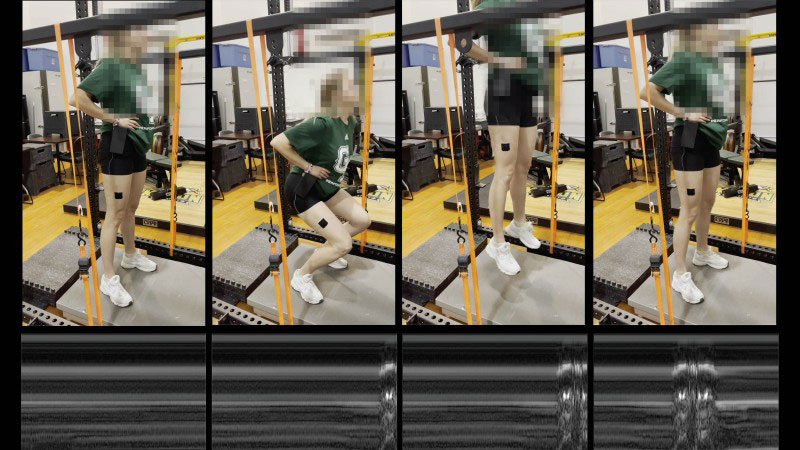
A wearable ultrasound monitor can provide insight into dynamic muscle movement during activities like jumping. Image courtesy of Parag Chitnis.
Parag Chitnis, PhD, of George Mason University led a team that developed a wearable ultrasound system that can produce clinically relevant information about muscle function during dynamic physical activity.
Many medical technologies can give doctors a window into the inner workings of a patient’s body, but few can be used while that patient is moving. A wearable ultrasound monitor can move with the patient and provide an unprecedented level of insight into body dynamics. “For instance, when an individual is performing a specific exercise for rehabilitation, our devices can be used to ensure that the target muscle is actually being activated and used correctly,” said Chitnis. “Other applications include providing athletes with insights into their physical fitness and performance, assessing, and guiding recovery of motor function in stroke patients, and assessing balance and stability in elderly populations during routine everyday tasks.”
To design the wearable ultrasound device, Chitnis and his team reinvented ultrasound technology nearly from scratch to produce the results they needed. “Traditionally, ultrasound systems transmit short-duration pulses, and the echo signals are used to make clinically useful images,” Chitnis said. “Our systems use a patented approach that relies on transmission of long-duration chirps, which allows us to perform ultrasound sensing using the same components one might find in their car radio.”
This modified approach allowed the team to design a simpler, less expensive system that could be miniaturized and powered by batteries. This let them design an ultrasound monitor with a small, portable form factor that could be attached to a patient. Chitnis hopes to further improve his device and develop software tools to more quickly interpret and analyze the ultrasound signals.