








By M. Mark Melin, Caroline Fife, Marlin Shul, Monika Gloviczki, Adelaide Herbert, Heather Barnhart (Hettrick), Amy Kaufman, Karen Andrews, Sandra Rosenberg
Venous Leg Ulcers: Make the Correct Diagnosis
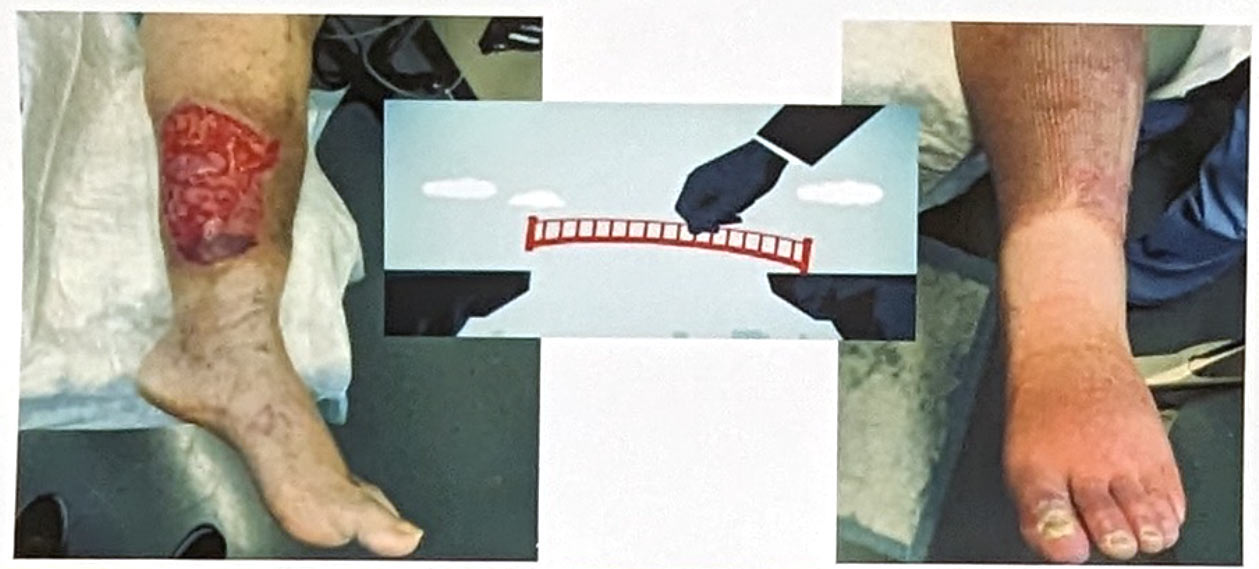 To achieve the best outcomes for patients with venous leg ulcers (VLU), a definitive and accurate diagnosis must be achieved. Many papers regarding VLU management assume a simplicity in the diagnosis given the relative commonality, neglecting the associated lymphatic dysfunction resulting in chronic lymphedema and the associated difficulty in health with venous axial ablation alone and subsequent potential for higher recidivism rates. To maximize a national effort to improve sustainable outcome improvements in VLU collaborative management, bridging the existing gaps between vein and wound centers requires leveraging enhanced education endeavors and integrating databases to document improvement in validated Societal guideline utilization. Two potential databases that could serve this purpose are the US Wound Registry and the American Vein & Lymphatic Society (AVLS) Patient Reported Outcome (PRO) Venous Registry databases.
Database integration requires a common shared clinical definition of VLUs and accurate consistent identification and documentation of veins treated. Clinical VLU diagnosis would first exclude the presence of tendon or bone in the wound bed, as this typically would be indicative of atypical ulcers (peripheral arterial disease, pyoderma gangrenosum, vasculitis, neoplastic, vasculopathic, infectious). Organ dysfunction (cardiac, pulmonary, renal, hepatic), obesity and edema-genic medications resulting in significant lower extremity edema and ulceration must also be identified and corrected given that venous axial ablation in these clinical scenarios is unlikely to achieve expected outcomes of wound closure and carry a higher association complication rate. The clinical characteristics of a true VLU are typically epidermal and dermal loss extending into the subcutaneous tissues, ranging from limited wounds along the medial calf to near circumferential dermal loss. Duplex venous reflux ultrasound evaluation identifies axial and/or deep venous reflux with associated branch varicosity incompentency and potentially refluxing perforating veins. 2023 AVLS PRO data demonstrated 85% of leg wounds are venous in origin and 97% possess surgically correctable disease in 1,794 unique subjects (1,878 limbs). Significant gaps in AVLS PRO data are documentation of mixed ulcers (presence of peripheral arterial disease), a diagnosis of diabetes (estimated prevalence rate 10-15% in VLUs), and accurate identification of atypical ulcers, all factors that may impact decision making for reflux intervention and impair outcomes. This gap could be potentially bridged with integration of US Wound registry data points that include these critical components in wound assessment.
Lymphedema: a Vastly Underdiagnosed Condition
The lymphedema component of VLUs remains vastly underdiagnosed, underrecognized, and undertreated. The US Wound Registry identified 29,298 patients with venous stasis or venous insufficiency as of October 2015, representing 24.3% of all patients in the registry. Of this group, 4,029 patients were simultaneously diagnosed with lymphedema, although this likely represents a gross underestimation at only 13.7%. By definition, all patients with VLUs have lymphatic dysfunction as demonstrated in Near Infrared Fluorescence Imaging (NIRFLI). VLUs were noted to be the leading cause of secondary lymphedema diagnosis at a tertiary referral center, not the diagnosis of cancer associated lymphedema. The integrated collaborative and data collection enhancement of both the US Wound Registry and the AVLS PRO databases could vastly improve the appropriate diagnosis of lymphatic dysfunction/lymphedema as a critical component of “phlebolymphedema,” creating new measures of treatment documentation and outcomes determination. Lymphedema education, therapeutic feedback and documented potential patient quality of life outcomes with respect to VLU and lymphedema therapies could have vast health care economic implications. Successful lymphedema of venous etiology management benefits from a Certified Lymphedema Therapist (CLT), a persistent relative novelty for many vein and wound centers. Lymphedema pump utilization in CLT “deserts” may be assistive. Underrecognized components that would benefit from additional research within databases include micronutrients that enhance endothelial function (B vitamins, Vitamin D, arginine), diosmin Micronized purified flavonoid fractions (MPFF), other venotonic/lymphotonic therapeutics, and endothelial glycocalyx restorative and regenerative interventions (Sulodexide, diosmin, MPFF), assessment of single nucleotide polymorphisms (SNPS) and other genetic/epigenetic factors.
TAKEAWAYS
Vein and wound center patient treatment goals are aligned; improve patient outcomes and quality of life.
- Significant gaps are present in accurate clinical diagnosis, exclusion of atypical leg ulcerations for venous ablation, recognition of mixed venous ulcerations, the recognition and appropriate treatment of lymphatic dysfunction/lymphedema with integrated CLT management.
- The US Wound Registry and the AVLS PRO databases are both nationally recognized resources, providing Society level information to clinicians.
- If we are to bridge the gap to truly new levels of holistic and systemic patient care metric achievements, we must bridge datasets to harvest the highest yield. The opportunity to improve patient care for those suffering with VLUs and lymphedema is at hand and with a renewed sense and purpose of venous, lymphatic wound and CLT leadership.
Source: Melin MM. Fife C, Shul M, Gloviczki M, Herbert A, Barnhart (Hettrick) H, Kaufman, Andrews K, Rosenberg S. Venous Leg Ulcers and Concomitant Lymphedema: Bridging the Gap in Diagnosis and Treatment of Dual Dysfunction Within Vein and Wound Care Centers. Poster presented at 2023 Union of International Phlebotomy World Congress and 37th Annual Congress of the American Vein & Lymphatic Society. Sept. 17-21, 2023; Miami Beach, FL.




While researching options for treating spider veins, I ended up checking out the best vein center near me. I was pleasantly surprised by the technology used and how they explained everything in a way that made me feel confident moving forward with treatment