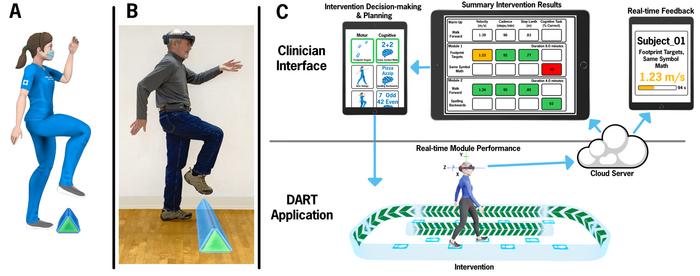








A) An avatar demonstrates physical therapy exercises on the DART platform. B) A user wearing an augmented reality headset follows along with the program. C) The headset records and analyzes user progress for clinician review. Image courtesy of Cleveland Clinic.
An augmented-reality (AR) headset is an effective digital tool for improving posture, gait, and “freezing” in people with Parkinson’s disease, according to a recent Cleveland Clinic trial. The “Dual-task Augmented Reality Treatment” (DART) uses the Microsoft HoloLens2 to run patients through dual-task training (DTT), a series of tasks designed to engage the brain and body simultaneously.
Activities are designed to counter Parkinson’s disease’s effect on the parts of the brain that control mental and physical tasks. Think about walking while listening to an audiobook or talking while shopping at the grocery store. DTT helps address the lack of balance and stability that can lead to falls or difficulty moving, said Jay Alberts, PhD, Center for Neurological Restoration. This therapy, although effective, isn’t widely used because of the time and resources it takes to measure patient progress and personalize a program, among other limitations.
Instead of a human therapist, the DART program uses a digital avatar named Donna, named after Alberts’ mother. The user wears the AR headset and sees Donna in their line of sight. The user then hears instructions through the headset, which tracks their movements and responses. Donna guides the exercises and demonstrates movements. The headset collects data for clinicians to review and use to design future sessions.
DART can create over 230 combinations of DTT activities. The clinical trial of just under 50 people compared results from participants in sessions led by an in-person therapist and those using the DART platform. Both groups showed comparable, clinically significant improvement after the therapy. Retention was also high for both groups.
DART is not meant to take the place of a physical therapist, but to serve as technology to enable more widespread use of DTT, said Alberts