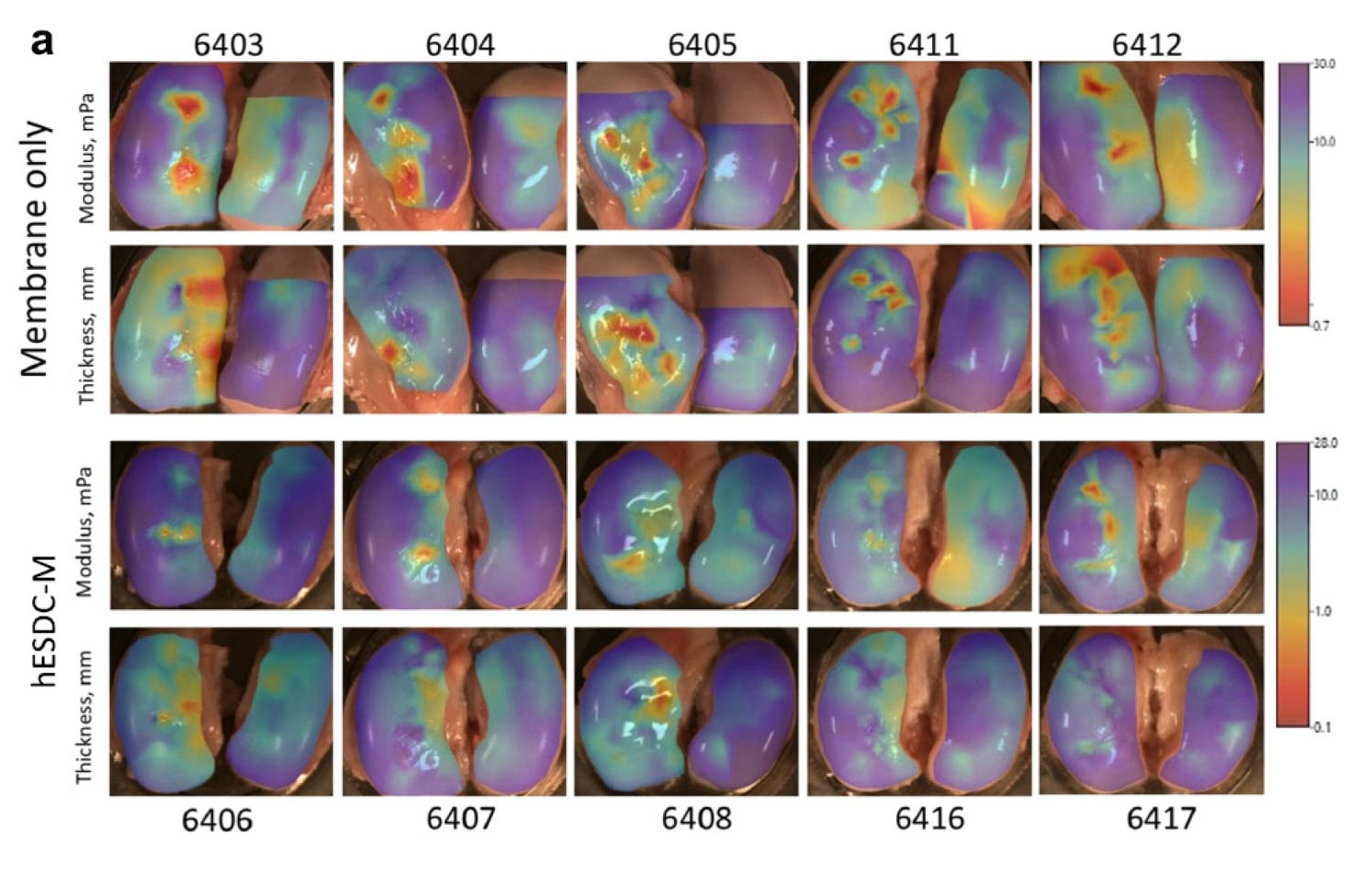
Figure. hESDC-M elicit biomechanically superior articular cartilage repair long term in porcine knees at 6 months. a) Heat maps depicting scanning indentation and thickness of femoral condyles generated using Mach-1 bioindentor; scale bars for instantaneous modulus (top rows) and thickness (bottom rows) are shown on the right. hESDC-M = human embryonic stem cell-membrane -bound; Membrane only = control.
A method to turn human stem cells into cartilage cells shows promise for repairing damaged joint tissue in a pig model of knee cartilage injury. The findings, funded in part by the National Institute on Aging and published in Regenerative Medicine, provide a potential new therapeutic strategy that may help repair damaged cartilage and prevent osteoarthritis.
In a new study, an international team of researchers refined a stem cell–based procedure that produces longer-lasting, higher-quality cartilage. The approach may also be easier to use in the clinic. To first test their theory, the researchers modified stem cells and implanted them into experimentally damaged knees in miniature pigs, which led to integration of the implanted stem cells and repair of the damaged cartilage. After 6 months, the repaired tissue had all of the physical and molecular characteristics of undamaged cartilage (figure). The tissue even got thicker and more compressible—qualities that help cartilage to cushion the joints. The study also found that the injected cells caused the pig’s own body to start making cartilage cells to further help in damage repair. The team also developed a liquid in which the injectable cells can be frozen and later revived, meaning the therapeutic cells could be transported to clinics and stored for an extended period.
While these cells did not cause an immune response in the pigs, more studies are needed to understand what might happen in humans and determine any potential adverse effects.
Source: Petrigliano FA, et al. Long-term repair of porcine articular cartilage using cryopreservable, clinically compatible human embryonic stem cell-derived chondrocytes. NPJ Regenerative Medicine. 2021;77(6). doi:10.1038/s41536-021-00187-3. Use is per CC BY.